

A parent’s guide to speech and language development for children aged 3 to 5, and how speech pathology can support your child’s growth.
The Importance of Early Childhood Communication
The period between ages 3 and 5 is a time of rapid growth in how children communicate. During these years, most children move from short, simple sentences to having conversations, telling stories, and asking detailed questions.
Research from organisations like the National Institute on Deafness and Other Communication Disorders shows that early childhood is an important time for speech and language development, as the brain is growing and adapting quickly.
At the same time, it’s important to remember that children develop at different rates. A wide range of communication styles and timelines can still fall within typical development. This information is intended as a general guide only and is not a diagnostic tool.
What Does Speech and Language Development Look Like at This Age?
Speech and language development includes two main areas:
- Receptive language (what a child understands)
- Expressive language (how a child communicates)
Around Age 3
- Follows two-step instructions (e.g., “Pick up the ball and put it on the table”)
- Uses sentences of about three to four words
- Familiar adults understand them most of the time
- Asks “what?” and “where?” questions
- Names common objects and begins to describe actions
Around Age 4–5
- Speaks in longer sentences and joins ideas together
- Tells simple stories and describes events from the day
- Understands concepts like colour, number, size, and time
- Takes turns in conversation and responds to questions
- Unfamiliar listeners generally understand their speech, though some sound errors (such as “r,” “th,” and “v”) may still be developing
These milestones are general guides. Children, including those growing up with more than one language, may develop skills in different ways or at different times.
When Might It Be Helpful to Seek Advice?
Some communication differences are part of typical development. However, it may be worth discussing your child’s communication with a professional if you notice patterns that are consistent over time or across different settings, such as:
- Speech that remains consistently difficult for others to understand
- Using significantly fewer words than peers of a similar age
- Ongoing difficulty following simple or routine instructions
- Not combining words into short sentences by age 3
- Frequent frustration when trying to express needs or ideas
- Challenges with social interaction and back-and-forth conversation
- A limited interest in books, storytelling, or engaging with others
- Frequent stuttering, especially if your child appears distressed
Noticing one or more of these does not necessarily mean there is a disorder. A qualified speech pathologist can help determine whether your child is developing as expected or whether support may be helpful.
What Does Speech Therapy for Preschoolers Involve?
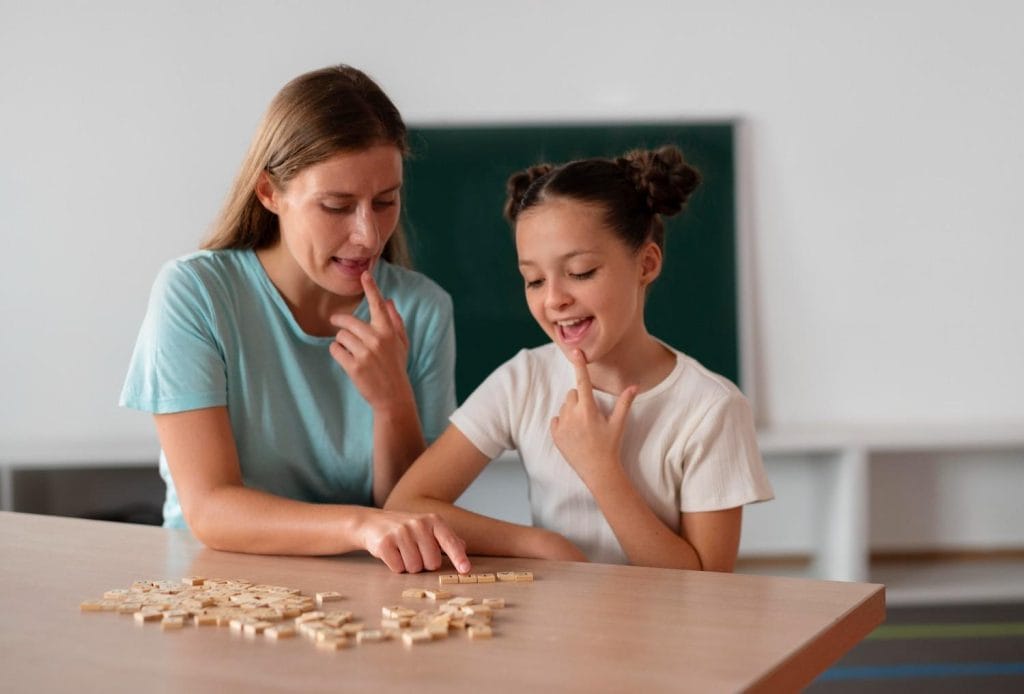
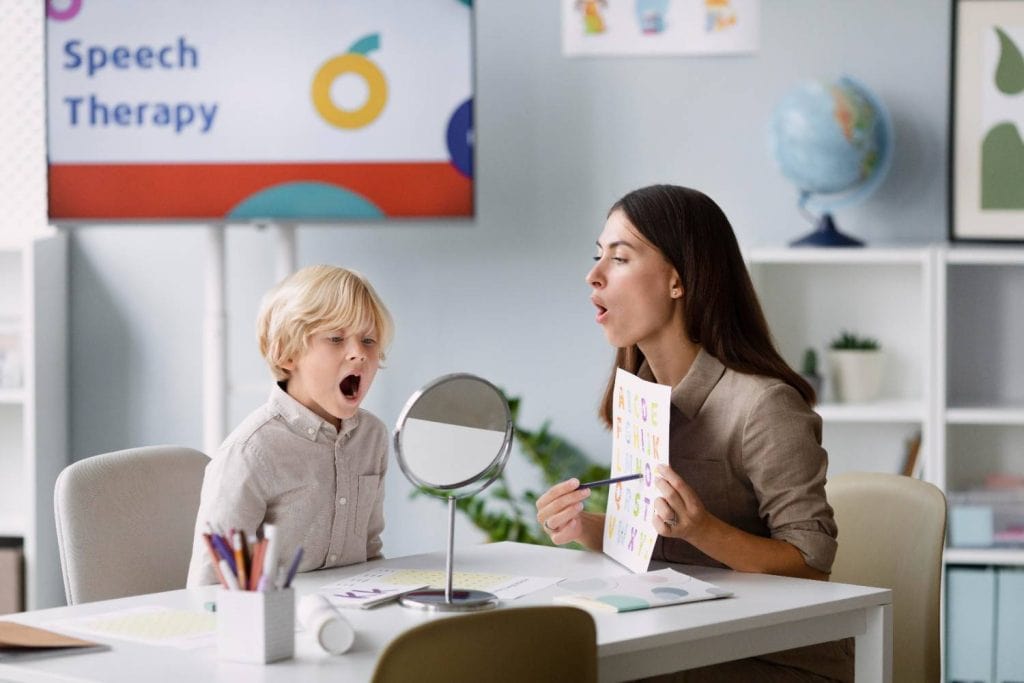
Speech therapy (speech pathology) for young children is typically play-based and tailored to the child.
An initial assessment looks at your child’s strengths and areas where they may need support. Therapy may focus on:
Therapy sessions may focus on areas such as:
- Speech sound development
- Vocabulary and sentence building
- Understanding and following instructions
- Social communication skills
- Early literacy skills (such as rhyming and sound awareness)
- Fluency support for children
Some research suggests that many children benefit from early support, particularly when families are involved in the process. However, outcomes vary depending on the child’s individual needs, and therapy is not a one-size-fits-all solution.
A speech pathologist will work with you to set realistic goals and discuss what progress may look like for your child.
How Parents and Carers Can Support Speech and Language at Home
Families play an important role in supporting communication development. The following strategies may help:
- Read together daily and talk about the story
- Describe everyday activities as they happen
- Give your child time to respond in conversations
- Expand on what your child says (e.g. “big dog” to “Yes, a big brown dog”)
- Sing songs and play rhyming games
- Prioritise face-to-face interaction over screen time
- Encourage and acknowledge all communication attempts
These strategies can support development but are not a replacement for professional advice if you have concerns.
Accessing Speech Pathology in Adelaide
If you’re considering speech pathology for your preschooler, there are several pathways available in South Australia:
- Private speech pathology clinics (such as Connect Allied Health), which also provide speech therapy for adults in Adelaide
- Community health centres through SA Health
- Services through your child’s childcare centre or preschool
- NDIS-funded services are an option, but eligibility and funding are not guaranteed and depend on individual participant plans and goals.
When to Seek an Assessment
There is no single “right” time to seek support. If you have concerns, an assessment can help you understand your child’s communication profile and whether:
- Development is within an expected range
- Monitoring progress over time is appropriate
- Targeted support may be helpful
Early support can be beneficial for some children, but it’s also important to recognise that development is not linear, and children progress at different rates.
How to Get Started
If you’d like to learn more about speech pathology for your preschooler, or if you’d like to book an initial consultation, you’re welcome to contact our team. We’re happy to answer questions and help you understand what the process involves.
Phone: (08) 8337 8770
Disclaimer: This article provides general educational information about speech pathology for preschool-aged children. It is not a substitute for professional assessment or medical advice. If you have concerns about your child’s communication, we encourage you to consult a qualified speech pathologist.
References
Beaming Health. (2025). Speech Therapy Statistics 2025: How Common Are Communication Disorders and How Well Does Speech Therapy Work? beaminghealth.com/article/speech-therapy-statistics
National Institute on Deafness and Other Communication Disorders (NIDCD). Speech and Language Developmental Milestones. nidcd.nih.gov/health/speech-and-language
American Speech-Language-Hearing Association (ASHA). Communication Milestones: 3 to 4 Years. asha.org/public/developmental-milestones/communication-milestones-3-to-4-years
Billioti de Gage, S., et al. (2025). Relative Age in School and Initiation of Speech Therapy in Children. JAMA Network Open, 8(5), e2512262.
McAllister, T., et al. (2024). Biofeedback Speech Therapy for Children with Residual Speech Sound Disorder. Journal of Speech, Language, and Hearing Research.